Fire and smoke detection is live on the Edgegenix Edge AI Core
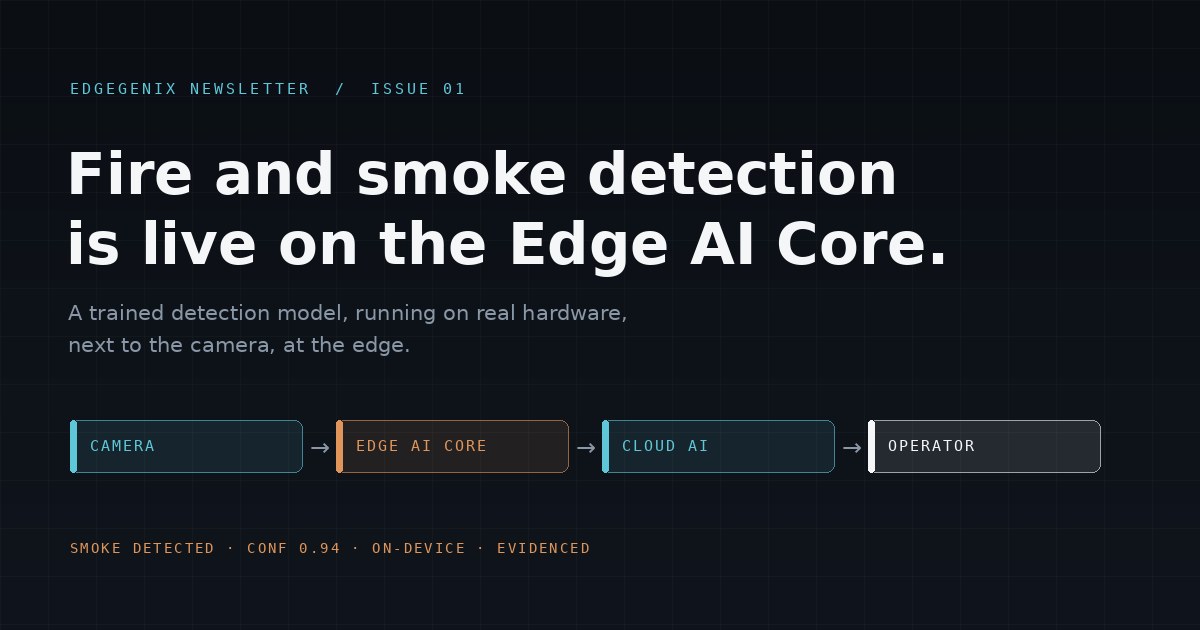
Today we can share a milestone. The Edgegenix Edge AI Core, the on-device foundation of our platform, is live in the field and detecting fire and smoke on real camera streams.
This is not a lab result or a demo reel. It’s a trained detection model running on real hardware, next to the camera, at the edge. An ordinary camera becomes an always-on set of eyes for the earliest signs of ignition. And the first minutes are the ones that decide whether an incident stays small.
The difference between an alert in the first minutes and an alert an hour later is the difference between a contained incident and a catastrophe.
But early on its own isn’t enough. An operations room buried in false alarms learns to tune the system out, and that costs trust exactly when trust matters most. So this capability was built to verify on the device, cutting false alarms before they ever reach a person. Fewer, better alerts. That’s the standard.
We learned early that one generic model isn’t enough. A camera bolted to a vehicle at close range sees the world completely differently from a camera on a distant tower scanning a landscape. So rather than force one compromise model to do everything, we built a family of purpose-built detection models, each tuned to how its camera actually sees the scene. Close-range and wide-landscape are live today. Thermal discrimination comes next, for telling a genuine ignition apart from harmless industrial emissions.
Each model was trained on a large, curated body of real-world fire and smoke imagery spanning different conditions, distances, lighting and environments. Then it was validated on the actual target hardware before we called it deployed. That last discipline matters. A model that looks perfect on a server can behave very differently once compiled onto an edge device, and we don’t ship anything we haven’t proven in the field.
The detection runs on the device itself, not in the cloud. The camera streams into a small, rugged edge computer sitting right beside it. That device decodes the video and runs the model locally, in real time. Only the result travels onward: smoke detected here, this confident, right now, along with the feed for an operator to see.
That design buys three things that matter in the field:
The edge device senses and recommends. It never acts on its own.
A detection becomes a recommendation that flows up to the Cloud AI operations platform, where raising an alert or notifying a person is a separate, deliberate step, with a recorded trail of what was seen and when. AI carries the load. Operators keep command. Everything is evidenced. That principle is wired in from day one, because we designed for operational control, not black-box autonomy.
Fire and smoke detection isn’t a standalone product. It’s the first capability plugged into the Edgegenix Edge AI Core: the reusable foundation that pulls any camera stream, runs a model on-device, buffers evidence through network outages, streams video, and uplinks its findings to the operations platform where people act.
The model is a swappable component, not baked into the box. We can update or replace it over the air, with no truck roll and no re-flashing, and the device keeps running. The same software runs on more than one class of hardware, so a compact demo unit and a hardened production tower unit run the very same container.
Which is why this scales far past fire. A new use case is mostly a new model, not a new product. The same architecture that spots smoke on a hillside can watch powerlines for vegetation encroachment and thermal faults, audit a road network from ordinary council vehicles, fuse a mine site’s systems into one live operating picture, keep fleet data flowing through comms outages, and give a fire crew thermal sight through smoke. Those are the operations our platform serves today, and every one of them inherits the same edge-first advantages and the same evidence trail.
Thermal detection for distant and industrial settings. Hardened production tower units. More cameras onto the Cloud AI operations platform. Each step strengthens the Core, and the Core is what every future capability stands on.
We built an edge AI platform and taught it to see fire first.
Edgegenix · The intelligence layer between signal and decision
Tell us your operational context. We’ll make the 30 minutes count.